




Adobe-style desert homes lit by warm outdoor lighting at dusk, with saguaro cacti in the foreground and a rocky mountain range behind them.

Mini Split Installation in Gardnerville Ranchos, NV

Tell us about the job

Takes about a minute. No obligation.

New system or replacementMini-splitDouglas County, NV
Step 1 of 2

What ZIP code is the job in?

Gas heats 71.3% of homes in Douglas County, more than any other fuel. A mini split works differently. It runs on electricity and handles both heating and cooling from the same unit, so it's often going in where someone wants air conditioning added, or wants a room covered that the gas furnace doesn't reach well. Electricity already heats 13.5% of homes here, so running a mini split alongside or instead of a gas system isn't unusual for this area. Worth knowing going in whether you're adding to what you have or replacing it outright.

10 months
September through June, your system heats
2 months
July through August, it cools
24°F
the average winter night it heats against
82°F
the average summer afternoon it cools against
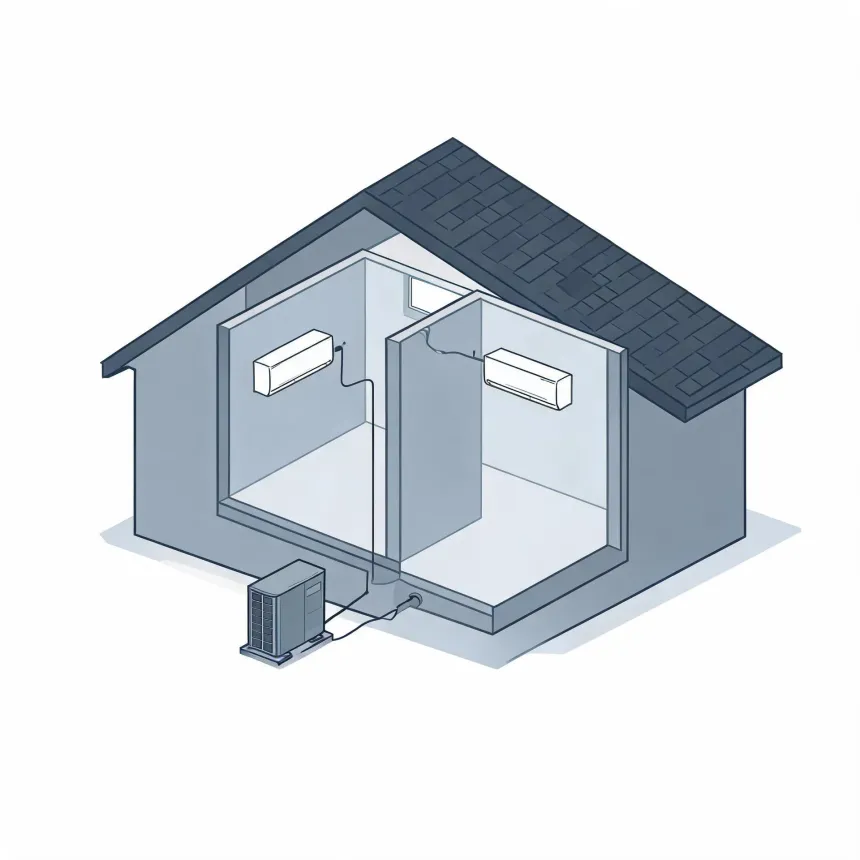
Isometric line illustration of a cutaway house with two rooms, each with a wall-mounted indoor air conditioning unit connected by lines to an outdoor condenser unit on the ground outside.
Your system heats September through June and cools July through August.

NOAA nClimDiv, 1991–2020 normals

Cooling in Gardnerville Ranchos runs about two months, July through August.

June is the month to get a mini split installed, before the first hot day finds it still on order.

Cheap power here means payback is slow, so pick the system that fits the room

Power costs 15 cents a kWh statewide
Climate zone 4B
Cooling runs July through August

Cooling runs about two months here, July and August, with afternoon highs averaging 82°F. That's mild work for a mini split, nowhere near the kind of heat that has a system fighting all summer long. Wind shows up far more often in Douglas County, with damaging wind hitting the area 290 times over the past decade. That makes where and how the outdoor unit gets mounted more important than chasing another efficiency point. A reliable mid-range system, set up with the wind in mind, holds up fine here.

Any system going in here has to meet zone 4B's minimum

Douglas County sits in climate zone 4B. Any mini split installed here has to clear 14.3 SEER2 for cooling and 7.5 HSPF2 for heating. That's the federal minimum, not a suggestion. A federal tax credit is available on qualifying systems, which helps offset choosing one that clears the bar with room to spare.

Find a contractor
A man in a gray long-sleeve shirt, brown work pants, boots and a dark cap walks up porch steps toward a red door, carrying a worn canvas tool bag.
A white outdoor air conditioner condenser unit mounted on metal wall brackets against gray horizontal siding, with a blue sky and white clouds behind it.

Two months of real work

Two months a year of that kind of work is not much wear. A system here spends most of its life idle, so the parts that run, the compressor and the fan motor, aren't under the strain they'd see somewhere hotter. That's in the system's favor when something does need fixing down the line. It's also why a mid-range unit holds up as well as a higher-end one here. Neither is working hard enough for the difference to show.

How many rooms it has to reach

A single room needs one indoor head and one outdoor unit. Cover several rooms and you're into a multi-zone system, with more line sets, more refrigerant, and more labor to run everything back to one outdoor condenser. Each added zone raises the job, not just the equipment list.
What the outdoor unit sits on and against

The line between the indoor head and outdoor unit has to run somewhere, through a wall or up and over, and that path decides how much work the install takes. A straightforward run costs less labor than one that has to clear framing or run a long distance. Where the outdoor unit mounts matters too, since a pad or bracket built to hold up matters more than saving a step there.

If this is replacing a gas furnace or an old wall unit, the old equipment doesn't have to come out the same day. Most of the time it gets disconnected once the mini split is running and tested, so there's no gap in heat or air while the new system goes in. A furnace being decommissioned needs the gas line capped off properly, not just shut at the valve. If the old system used ductwork that the mini split won't need, that ductwork can usually stay in place or get sealed off, whichever makes sense for the room. An old outdoor condenser gets disconnected from power and hauled off along with its refrigerant line, and that refrigerant has to be recovered properly rather than vented. None of that work should hold up when the new system actually turns on.

Install day starts with the indoor head going up, mounted high on a wall or in the location the layout called for, with a small hole drilled through to the outside for the line set. That line set carries refrigerant lines, a drain line, and electrical in one bundle, run to wherever the outdoor unit sits. Once both ends are connected, the line gets pressure tested to check for leaks before anything is charged. Then the system gets evacuated to pull moisture and air out of the lines, because either one left behind causes problems down the road. After that it's charged with refrigerant, powered up, and run through both heating and cooling to make sure the head responds and the outdoor unit cycles the way it should. A straightforward single-zone job is usually done in a day. Add zones and the day gets longer, since each indoor head needs its own line set run back to the outdoor unit.