




A gray cat sleeps curled up on a dark-made bed in a moody, minimalist bedroom with a wall-mounted air conditioning unit and warm accent lighting.

Mini Split Installation in Hawthorne, NV

Tell us about the job

Takes about a minute. No obligation.

New system or replacementMini-splitMineral County, NV
Step 1 of 2

What ZIP code is the job in?

Propane heats more homes in Mineral County than anything else, close to half. A mini split works alongside that instead of competing with it. Many homes here use propane for a furnace or boiler and window units or nothing for cooling, and a mini split handles the cooling load without touching the gas line. It also gives you heat in the shoulder months without lighting the furnace at all. If your home runs on propane now, adding a mini split is usually about running new electrical and refrigerant lines, not reworking how the house is heated.

8 months
October through May, your system heats
2 months
July through August, it cools
22°F
the average winter night it heats against
86°F
the average summer afternoon it cools against
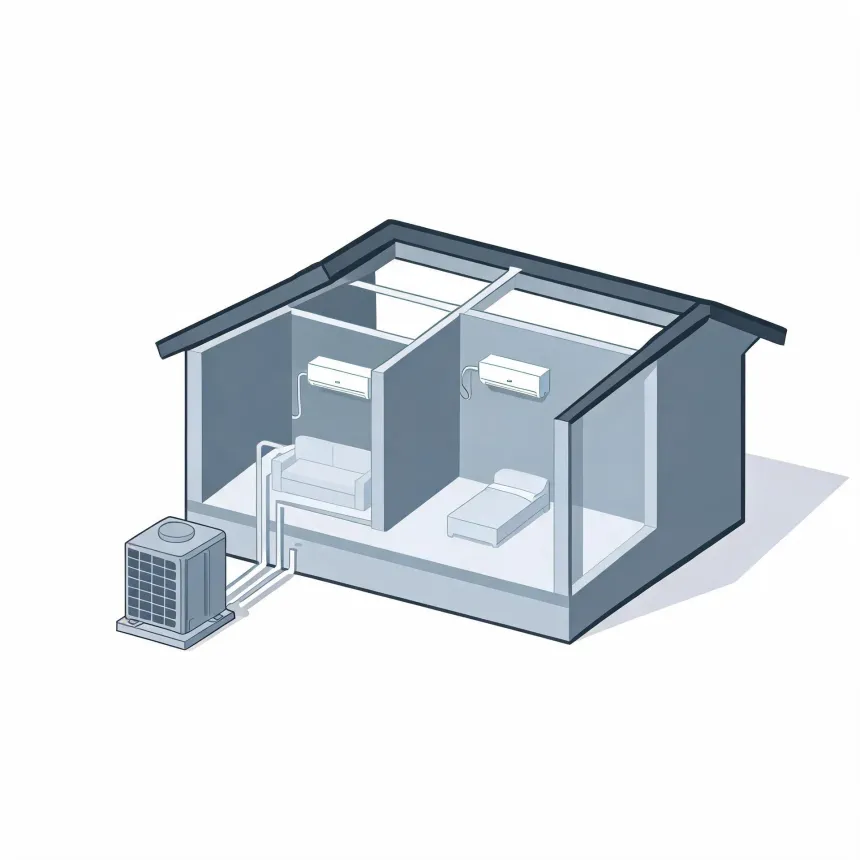
Illustrated cutaway of a two-room house showing two wall-mounted indoor air conditioning units connected by pipes to an outdoor condenser unit on the ground outside.
Your system heats October through May and cools July through August.

NOAA nClimDiv, 1991–2020 normals

Nevada electricity ran 15 cents a kilowatt-hour in 2024.

A mini split sized for this house keeps that cost predictable instead of oversized and wasteful.

Two months of cooling is short, which is exactly why June is the month to get it installed

Cooling runs July through August
Summer afternoons average 86°F
61 damaging wind events from 2015 to 2024
Two months of real heatHawthorne needs cooling from July through August, with afternoons averaging 86°F

Hawthorne sits in climate zone 4B, so any mini split installed here has to clear 14.3 SEER2 for cooling and 7.5 HSPF2 for heating. That's the federal minimum for split-system heat pumps, and a ductless system counts as one even though it has no ducts. There's no separate, lower bar for going ductless. If you install a unit manufactured from 2023 onward, it has to meet those numbers regardless of brand or size. A system that clears this standard also tends to qualify for the federal tax credit, which runs through purchases made this year. Ask whichever contractor you're comparing for the AHRI certificate on the exact unit, not just a number on a brochure.

Older homes here don't need new ducts to get a mini split

Half the homes in Mineral County were built in 1971 or earlier. A mini split doesn't need ductwork, which matters in a house that age, since there's often none to tie into or none worth extending. Mounting a head on the wall and running a line set to an outdoor unit sidesteps whatever is or isn't behind the walls. That's worth asking about now, while you're sizing the system, not after it's in.

Find a contractor
A white mini-split air conditioner outdoor condenser unit mounted on metal brackets against a beige stucco exterior wall, with a blue sky and scattered clouds in the background.

Light work most of the year

Two months of cooling a year is light duty for a mini split, and the heat it's fighting tops out around 86°F, not the triple digits systems deal with elsewhere. That's a system that can cycle on, do its job, and shut off again without much strain. You don't need to pay for the highest-efficiency unit on the lot to get solid performance here. Put the money into the right size for the room and a clean installation instead.

The line set sets the labor

Every foot of refrigerant line between the outdoor unit and each head has to be run, insulated, and brazed, then tested for leaks before it's sealed into the wall. A straight run through one exterior wall takes far less time than a line that has to climb, turn a corner, or cross to a far side of the house. The distance and the number of bends decide how long the crew is there, not just how many heads are going in.
Electrical work is often separate from the unit itself

A mini split needs its own dedicated circuit, and most homes don't have one sitting ready near where the outdoor unit will go. Running that circuit, whether from the panel directly or through a disconnect box outside, is electrical work billed apart from the mounting and the line set. If the panel is already full, adding that circuit can mean more than just a new breaker.

Sizing a mini split is about matching the heat gain of the room to the output of the head, not picking a bigger unit for peace of mind. An oversized head cools the air fast, hits the thermostat setting, and shuts off before it's pulled the moisture out of the room, so the space feels cool but clammy. One that's too small runs constantly and never quite catches up on the hottest afternoons. The right size runs longer, steadier cycles, which is also what keeps the compressor from wearing out early. Getting there means a room by room load calculation, not a square footage chart, because window size, insulation, and which way a room faces all change the number. Ask whoever quotes the job to walk through that math with you rather than hand you a unit picked off a chart.

Installation day starts outside, not in. The outdoor unit gets mounted on a pad or bracket first, then whoever's running the job figures out the path for the line set, the bundle of refrigerant lines and wiring that connects it to each indoor head. That path matters more than people expect, since every bend and every foot of extra line is a place for a connection to fail later. Once the line set is run and the holes are sealed, the indoor head goes on the wall and the lines get connected, then the whole system gets evacuated with a vacuum pump before any refrigerant moves. That step pulls out moisture and air that would otherwise sit in the lines and cause problems down the road. Only after that does the system get charged, powered up, and tested room by room.