





A white wall-mounted split air conditioner on a blue-grey wall, with a moonlit night sky visible through a nearby window.

Mini Split Installation in Lovelock, NV

Tell us about the job

Takes about a minute. No obligation.

New system or replacementMini-splitPershing County, NV
Step 1 of 2

What ZIP code is the job in?

A mini split for a Lovelock home doesn't need to be oversized or special to handle this area. Half the homes in Pershing County were built in 1984 or earlier, and a standard system from any licensed contractor is built to work with a house that age. More than half the housing stock here is mobile homes, and mini splits are a common fit for them since there's no ductwork to tie into. The right size comes down to the square footage and layout of your place, not anything unusual about the county.

8 months
October through May, your system heats
3 months
June through August, it cools
23°F
the average winter night it heats against
88°F
the average summer afternoon it cools against
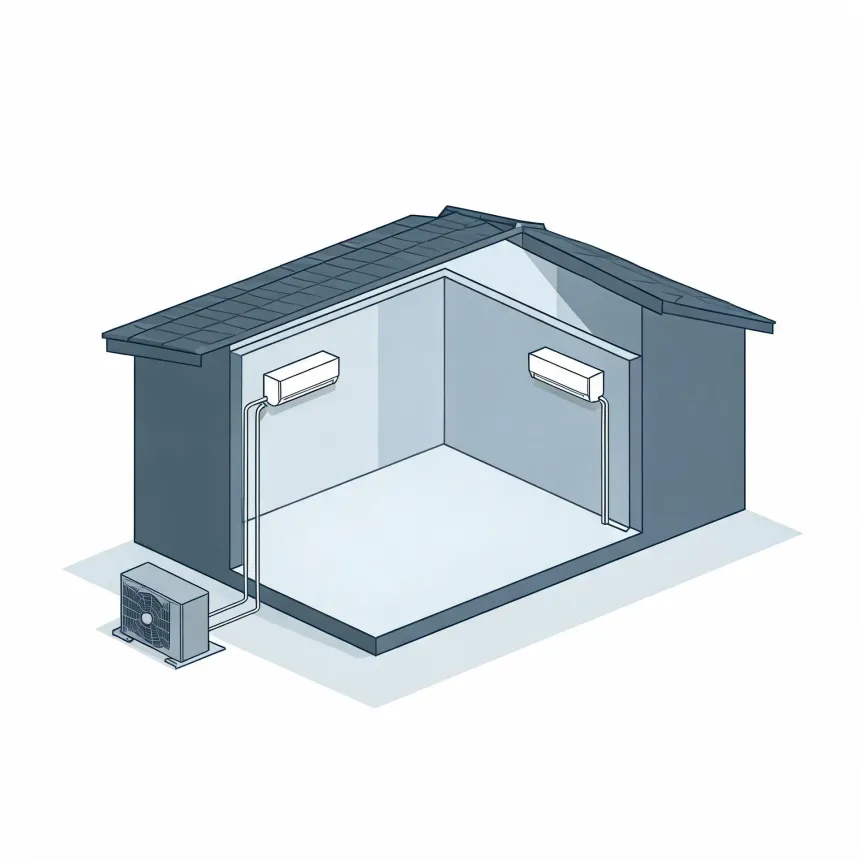
Cutaway isometric illustration of a small building interior showing two wall-mounted indoor air conditioning units connected by line sets running down to a single outdoor condenser unit on the ground outside.
Your system heats October through May and cools June through August.

NOAA nClimDiv, 1991–2020 normals

Three months of cooling, June through August, is all a mini split here needs to handle.

A system that doesn't have to run hard all year doesn't need top-tier efficiency to hold up.

Lovelock doesn't ask for more than a standard system

Power costs 15 cents a kWh statewide
Cooling runs June through August
Summer afternoons average 88°F
Get it in before JuneCooling starts in June and runs through August here.

Pershing County falls under zone 5B, a cool, dry climate where heating carries more of the load than cooling. Any mini split installed here still has to meet the federal minimum for a split-system heat pump, which is 14.3 SEER2 for cooling and 7.5 HSPF2 for heating. That standard applies whether the system is ducted or ductless, since the rule doesn't treat mini splits as their own category. It sets a floor, not a ceiling, so a licensed contractor can still install a higher-efficiency unit if that fits the home better. The federal tax credit for qualifying heat pumps is available on top of whatever model gets chosen.

Pick a system that fits, not one built for a harder climate

Three months of real cooling work doesn't call for the top of the lineup. A standard system installed right will hold up fine here. Get the sizing and the install done before June.

Find a contractor
A man in a dark t-shirt and tan work pants carries a worn canvas tool bag up wooden porch steps toward a red-orange front door of a gray-sided house, with a red ceramic planter holding a shrub to the right.
A beige split-system air conditioner outdoor condenser unit mounted on metal wall brackets atop a stucco wall.

Getting the size right

Sizing a mini split comes down to a heat loss and heat gain calculation, not a rule of thumb based on square footage alone. The calculation accounts for how many exterior walls a room has, how many windows it has, which way they face, and how the rooms connect to each other. A contractor doing this right measures the space and runs the numbers rather than matching tonnage to floor area off a chart. Oversizing is the more common mistake, not undersizing. A system too big for the space cools the room fast and shuts off before it pulls the moisture out of the air. The room ends up feeling cold and clammy at the same time. An oversized system also cycles on and off more than it should, and that short cycling wears on the compressor faster than steady runtime does. A system sized correctly runs longer, steadier stretches, which is what the compressor is built for in the first place. Undersized is the opposite problem. It runs constantly and still doesn't keep up on the hardest days. For a multi-zone setup, each indoor head gets sized to its own room. The outdoor unit gets sized to the combined load of every zone running at once, not just added up from the individual max capacities.

Ask who stands behind the whole system

A mini split has an indoor unit, an outdoor unit, a line set and a control board, and warranty claims get complicated when more than one party is responsible for a failure. Ask whether the warranty covers parts only or parts and labor, and for how long. Ask whether that warranty is void if anyone other than a licensed contractor ever opens the system for service.
Ask what happens if a zone fails, not just the whole unit

A multi-zone mini split runs several indoor heads off one outdoor unit, and that setup has a failure mode a single-zone system doesn't. Ask what happens to the other zones if one indoor head stops working, and whether a problem with the outdoor unit takes down every room at once or just the one tied to it.

Taking out the old system is its own job, separate from putting in the mini split. If the house had a furnace or central air before, the ductwork usually gets left in place even when it won't be used anymore, unless it's in the way of the new lines. An old window unit or wall sleeve comes out and leaves a gap that needs to be sealed up properly, not just covered over, or it's a draft point for the life of the house. If there's an old mini split being replaced, the refrigerant in it has to be recovered by someone licensed to handle it, never just vented off. Whoever does the installation should be able to say where the old equipment goes once it's disconnected.

Installation day starts outside, with the installer picking a spot for the outdoor unit that gives it clearance for airflow, a way for condensate to drain, and a reasonably short path for the line set to reach inside. Indoors, the mounting plate goes up first, then a hole gets drilled through the exterior wall for the line set to pass through. From there the installer connects the refrigerant lines, the condensate drain and the electrical wiring between the indoor and outdoor units. Before any refrigerant flows, the system gets pulled down with a vacuum pump to clear out moisture and air, since either one left behind causes problems later. Charging the system comes last, and it should be checked against the manufacturer's specs rather than just confirmed to blow cold or warm air. That last step is where a careful install shows, because it's what decides whether the system runs the way it's rated to or just seems fine at first.