





Two illuminated adobe-style desert homes at night, surrounded by saguaro cacti and low desert shrubs along a curved driveway.

Mini Split Installation in Reno, NV

Tell us about the job

Takes about a minute. No obligation.

New system or replacementMini-splitWashoe County, NV
Step 1 of 2

What ZIP code is the job in?

Most homes in Washoe County heat with utility gas, at 60.6 percent. Electricity comes next at 31.5 percent. A mini split runs on electricity, so it works differently from the furnace most of this area is used to. It heats and cools from the same unit, and it does both by moving heat rather than burning gas to make it. That makes it a common choice for a room addition, a garage, or a house that has no ductwork to extend.

8 months
October through May, your system heats
2 months
July through August, it cools
23°F
the average winter night it heats against
84°F
the average summer afternoon it cools against
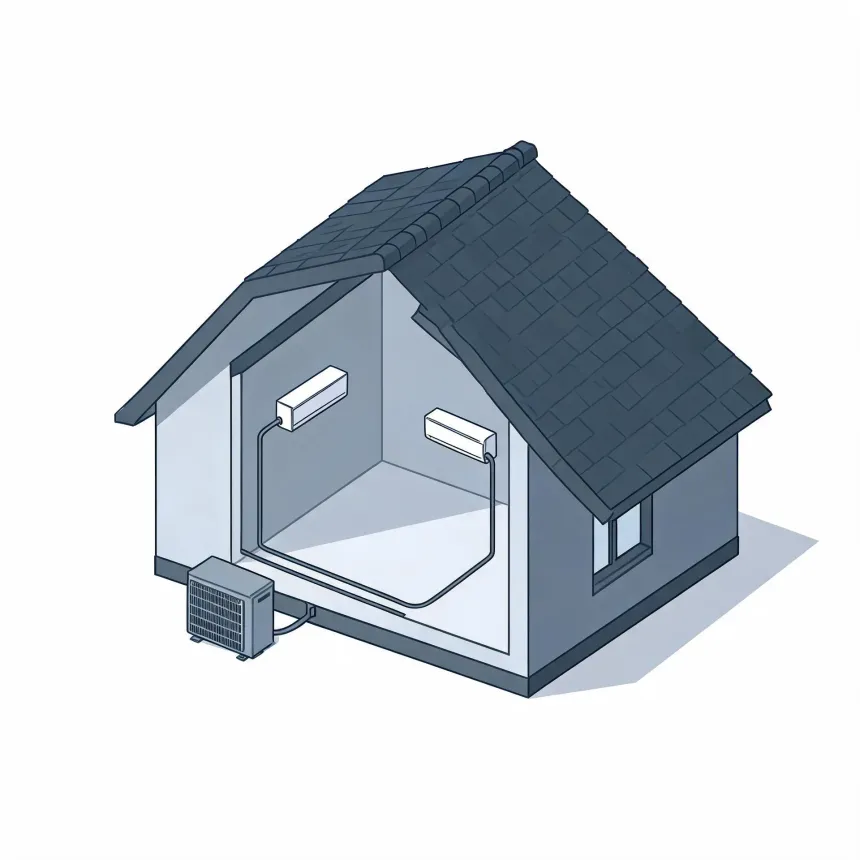
Isometric cutaway illustration of a small house with a shingled gable roof, showing two wall-mounted indoor air conditioning units connected by refrigerant lines to an outdoor condenser unit on the ground outside.
Your system heats October through May and cools July through August.

NOAA nClimDiv, 1991–2020 normals

Reno gets two months of real cooling, July and August, with afternoon highs around 84°F.

A mini split here isn't fighting triple digits all summer, so a mid-range unit will keep up fine.

Cooling starts in July, so have it in before June is out

Cooling runs July through August
Climate zone 5B
Power costs 15 cents a kWh statewide
Built for Reno weather, not against itWashoe County sees wind and winter storms most years, but nothing here calls for oversizing a mini split.

Nevada homes paid 15 cents per kilowatt-hour in 2024. That's the rate a mini split runs on, so it's worth knowing before you size one up. A standard mid-range unit sized to the room or addition it's covering will run fine here. There's nothing about Reno's climate that calls for a bigger compressor or a higher-tier model. Oversizing costs more up front and doesn't buy you anything this area's weather would use.

A new mini split here has to clear a set efficiency floor

Washoe County sits in climate zone 5B, where heating is the bigger job. Any mini split installed here has to meet the federal minimum for a split-system heat pump. That means 14.3 SEER2 for cooling and 7.5 HSPF2 for heating, ductless units included. That floor limits what a contractor can install, so it's worth knowing before you settle on a system. A federal tax credit is available for qualifying heat pump installations, and it's worth checking into before you buy.

Find a contractor
A man in a cap and work jacket, seen from behind, carries a canvas tool bag up wooden porch steps toward a red front door.
A white mini-split air conditioner outdoor condenser unit mounted on metal brackets against a beige stucco exterior wall, with a blue sky and scattered clouds in the background.

Light duty most of the year

Two months of cooling a year is not much work for a compressor. Run the numbers over a system's life and that mini split spends most of its time idle or heating, not pushing against an 84 degree afternoon. There's no case here for buying past what the room needs. Put the money into a unit sized right and installed clean, not into extra capacity this climate won't ask for.

Ask what it takes to heat the room you're adding on to, not just cool it

A mini split's heating capacity drops as the outdoor temperature drops, and the spec sheet number is measured at a mild temperature, not a cold one. Ask for the capacity at a low outdoor temperature, not just the rated number, so you know what the unit actually delivers on the coldest morning it has to work.
Ask who services the brand locally

A mini split needs a contractor trained on that specific brand's controls and refrigerant system to diagnose a fault code or do warranty work. A unit with no one nearby to service it turns a small repair into a shipped part and a long wait, so ask before you buy, not after it breaks.

Installation cost comes down to how much work the job takes beyond the unit itself. The indoor and outdoor units connect through a wall by a line set, carrying refrigerant lines, a drain line, and electrical wiring. A short, straight run costs less than one that has to snake around framing or climb several floors. The outdoor unit needs a pad or bracket set on solid, level ground or wall, clear of anything that blocks airflow in or out. A mini split also needs its own dedicated circuit. If the panel has no room left, that's added work before the unit goes in. Multi-zone systems, where one outdoor compressor feeds several indoor heads, cost more than a single zone because each indoor unit needs its own line set and its own mounting work.

Sizing a mini split is not about matching square footage to a number on a brochure. A contractor works out the heat loss and heat gain for that specific room. That means counting exterior walls, windows, what's above and below it, which way it faces. Too big and the unit short cycles. It reaches the set temperature fast and shuts off before it's pulled any humidity out of the air, so the room feels cool but damp. Too small and it runs flat out without ever catching up on the hottest or coldest hours. Either mistake shortens the compressor's life, because the system spends its time working outside the range it was built for. A unit sized right cycles on, runs long enough to do the job evenly, and shuts off.