An outdoor HVAC condenser unit on a concrete pad in front of a two-story suburban house.

Heat Pump Repair in Hawthorne, NV

Tell us about the job

Takes about a minute. No obligation.

RepairHeat PumpMineral County, NV
Step 1 of 2

What ZIP code is the job in?

September is when it gets tested

Heat in Hawthorne starts up in October, and whatever was already weak on your heat pump tends to show itself in that first cold stretch. A worn contactor or a low charge can sit quiet all summer and then fail the first week it has to run heat instead of cooling.

Catching it before October pays off

A heat pump that struggles in its first week of heating usually had the same problem waiting since spring. Getting it looked at in September means it's fixed before you actually need it, not during the first cold night of the year.

8 months
October through May, your system heats
2 months
July through August, it cools
22°F
the average winter night it heats against
86°F
the average summer afternoon it cools against
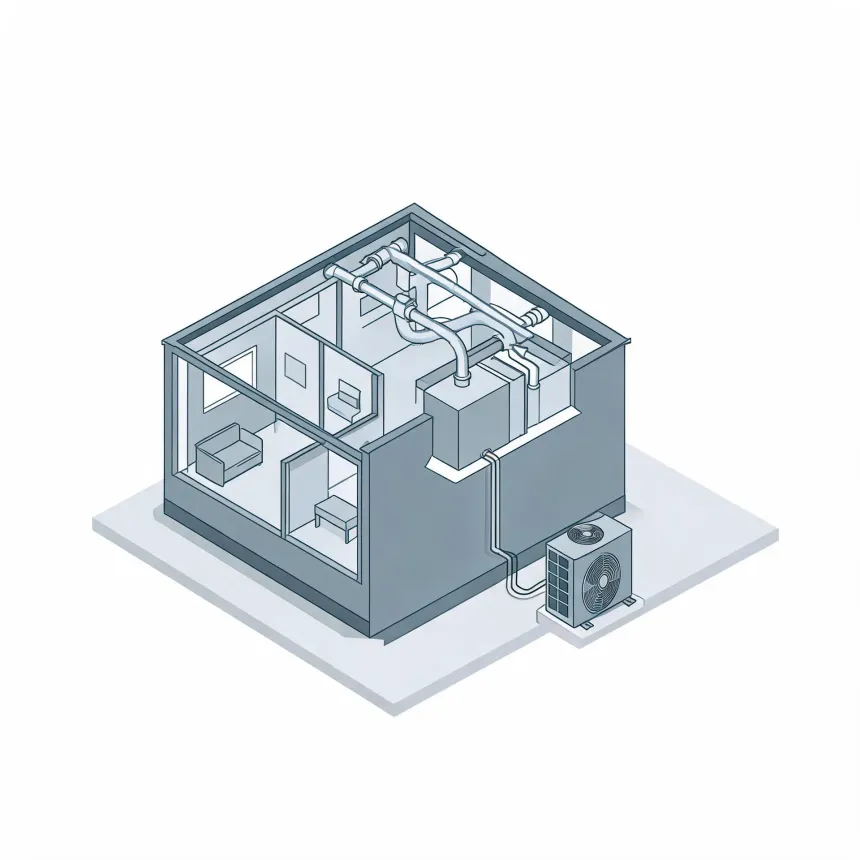
Isometric line illustration of a cutaway house showing interior rooms with furniture, ceiling ductwork connected to an indoor air handler, and refrigerant lines running to an outdoor condenser unit on a pad.
Your system heats October through May and cools July through August.

NOAA nClimDiv, 1991–2020 normals

Winter nights in Mineral County average 22°F, nothing close to the deep cold that pushes a heat pump hard.

A heat pump that runs through a mild winter picks up less wear, so most trouble in Hawthorne traces back to one weak part, not a system worn out from the cold.

Half the homes here are old enough that this isn't the heat pump's first system

Half the homes here were built by 1971
Climate zone 4B
Power costs 15 cents a kWh statewide
Electricity here runs 15 cents a kilowatt-hourA heat pump that's struggling costs you more here than almost anywhere else while it waits on a repair.

Most heat pump failures start with something mechanical, not the whole system giving out. The reversing valve is the part unique to a heat pump, and when it sticks, the system runs but blows cold air when it should be heating. Capacitors weaken over years of starting the compressor and the outdoor fan, and a weak one shows up as a unit that hums but won't start, or a fan that spins slow. The defrost board and its sensor control when the outdoor coil clears itself of ice, and if that board fails, the coil can ice over and stay that way until the system can't move heat at all. Contactors pit and burn from the arc of switching power on and off thousands of times, and a bad one leaves the outdoor unit silent while the indoor fan still runs. None of these start as a dead system. They start as a part doing its job a little worse each cycle, until one day it doesn't do it at all.

Ask how much life is left in it, not just what's wrong

If your heat pump came with the house, ask the technician how much life is left in it before you pay to fix what's failing now. That answer changes what a repair call is actually for.

Find a contractor
A gray heat pump condenser unit mounted on a concrete pad against the gray lap-siding exterior wall of a house.

What to check before you pick up the phone

Before anyone comes out, look at the outdoor unit. If the fan isn't spinning, or if it's caked in leaves and dirt so air can't move through the coil, that alone can stop the system cold. Check the thermostat is set to heat and the setpoint is actually above room temperature, since a setting bumped by accident gets blamed on the equipment more often than you'd think. Go inside and pull the filter. If you can't see light through it, swap it, because a blocked filter starves the whole system of airflow and can shut it down on its own. Check your breaker panel for a tripped breaker, especially after any power flicker. If the outdoor unit is running but the air coming from your vents feels cold instead of warm, mention that to the technician exactly as you noticed it, since it points toward a specific part rather than a general complaint. None of this requires opening the unit itself. Anything past the filter and the breaker is a job for someone with gauges and training.

A failing part rarely fails all at once

A contactor with pitted contacts or a compressor pulling bad amps will keep running in a weakened state before it quits outright. The heat pump cycles on, calls for help from parts that are struggling, and each cycle leaves them worse off than the one before. What would have been a single part swapped out early turns into a compressor replacement because it kept working under strain instead of being caught at rest.

Ice is the one that spreads fastest

A heat pump low on charge or short on airflow can start icing the outdoor coil, and once ice builds it blocks the airflow that was already marginal, so more ice forms. Left alone, that cycle can reach the compressor itself, the one part in the system a technician can't just swap out and move on from. A coil that's frosted over is telling you to shut the system down and get it looked at, not to wait and see if it clears on its own.

A heat pump rarely just stops. It tells you first. Warm air that isn't quite warm enough, a fan that cycles on and off more than it used to, a low hum from the outdoor unit where there used to be quiet. Short cycling is one of the clearest signs, the system kicking on, running a few minutes, then quitting before the house actually warms up. That pattern wears on the compressor every time it happens. A hissing or bubbling sound near the lines usually points to refrigerant, and that's not something to wait out, since a system low on charge will keep losing capacity until it can't keep up at all. If you notice a smell like burning dust the first time it runs after sitting idle, that's normal for a few minutes. If the smell lingers or turns sharp, that's not.

Repair makes sense when the failure is one part doing one job. A contactor, a capacitor, a fan motor, a defrost board. Swap it and the system goes back to doing what it was built to do. Replacement enters the picture when the compressor itself is the problem, since that's the part that moves the refrigerant and nothing else in the system does its job. A compressor swap costs enough that it starts to compete with putting that money toward a new unit instead. Age matters less than what's already failed and what that failure did on its way out. A system that iced over and ran that way for a while put extra strain on the compressor even if the compressor wasn't the original problem. Ask what actually failed and whether it took anything else down with it before deciding which way to go.