View from beneath a dark overhanging structure across a gravel yard toward a concrete block wall, a gnarled tree, and a single-story stucco house under a pale sky.

Heat Pump Repair in Pahrump, NV

Tell us about the job

Takes about a minute. No obligation.

RepairHeat PumpNye County, NV
Step 1 of 2

What ZIP code is the job in?

Winter nights put the heat pump to work

Overnight lows in Pahrump average 23°F through December, January and February. That's the stretch when a heat pump runs longest and any weak part, a failing defrost board or a low refrigerant charge, shows itself.

The cause is usually ordinary

A heat pump that's short cycling, running constantly or blowing cool air in winter almost always traces back to a handful of known causes. Finding which one it is matters more than how cold it got outside.

8 months
October through May, your system heats
3 months
June through August, it cools
23°F
the average winter night it heats against
88°F
the average summer afternoon it cools against
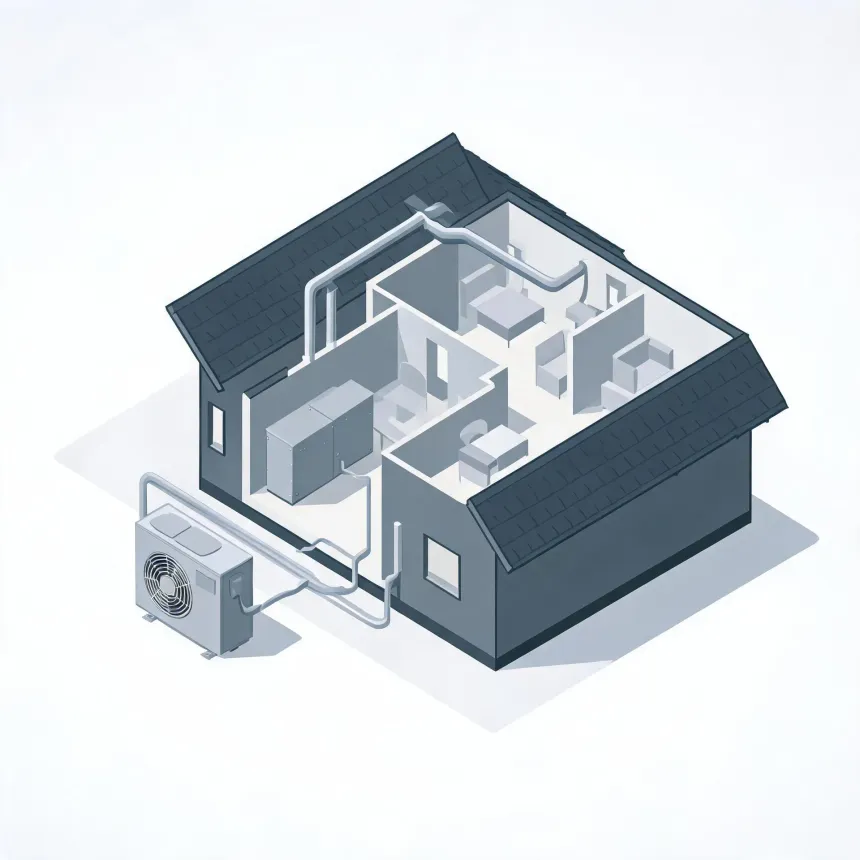
Isometric grayscale illustration of a cutaway house showing interior rooms, ductwork and an indoor air handler connected by lines to an outdoor condenser unit on the ground outside.
Your system heats October through May and cools June through August.

NOAA nClimDiv, 1991–2020 normals

Check the thermostat is set to heat, not auxiliary or off, and the temperature is set above room temperature.

A simple setting mix-up can look exactly like a broken heat pump, so rule it out before anyone drives out.

A system that's struggling now will run up that 15 cent rate all winter. Worth getting looked at before the cold sets in.

Power costs 15 cents a kWh statewide
Climate zone 4B
Cooling runs June through August

Nye County has had its share of wind and winter storms over the past ten years, but none of that is what ages a heat pump. Damaging wind can knock out power for a stretch, and a heat pump that loses power mid-cycle will usually restart on its own once service comes back. What actually wears on the parts inside the unit is the steady work of winter nights, not the weather events on the news. A heat pump here fails for the same reasons it fails anywhere. A defrost board stops switching. A contactor wears out from cycling on and off. A refrigerant charge drops low. The fix is finding which part it is, not guessing at the county.

Electricity here runs 15 cents a kilowatt-hour, and a struggling heat pump burns it all winter

Nevada homes pay 15 cents per kilowatt-hour, one of the higher rates around. A heat pump that's short cycling or running constantly draws power the whole time it does it, all winter long. Getting the actual cause fixed stops the extra draw, not just the symptom.

Find a contractor
A gray heat pump outdoor unit mounted on a concrete pad next to the stone-accented exterior wall of a house.

A newer system still has life in it

Half the homes in Nye County were built in 1998 or later. If your house falls on that side, the heat pump likely isn't old enough to be the problem on its own. A unit installed with a newer build still has working life left in it, and a breakdown points to one part failing, not the system wearing out. Worth checking what year your system went in, since that tells you more than the age of the house itself.

Warm air that isn't warm enough

A heat pump in heating mode should put out air that feels warm at the vent, not just less cold. Air that feels lukewarm often means the reversing valve is stuck between modes, or the system has lost refrigerant charge. Either way it's not something that clears up on its own.

Ice that doesn't go away

Some frost on the outdoor unit during a cold snap is normal, and the defrost cycle clears it on a schedule. Ice that builds up and stays, especially coating the coil or the lines, means the defrost board isn't switching the way it should. Running it like that can damage the compressor.

Most heat pump failures come down to a handful of parts that do the hardest work. The reversing valve switches the system between heating and cooling, and the coil that does that thousands of times a season is the one that eventually sticks. The defrost board watches for ice and tells the unit when to clear it. When that board fails, frost builds up on the outdoor coil and starves the system of airflow until the compressor is straining against it. The contactor is a simpler part, just a switch that opens and closes every time the unit cycles on, and like any switch it wears down with use until it stops making contact. Refrigerant doesn't get used up, so a low charge almost always means a leak somewhere in the line set or coil, slow enough that it shows up as weak heat months before it shows up as no heat at all.

A diagnostic visit starts with questions, not tools. When did the problem start, does it happen in heat mode or cool mode, has anyone heard clicking or buzzing before it quits. Then the gauges go on to check the refrigerant charge, because that one number points toward or away from a leak right away. The tech checks the contactor by looking for pitting on the contacts, and checks the defrost board by seeing whether it cycles the unit into defrost on command. Panels come off to look at the coil for ice or corrosion, and the reversing valve gets tested by listening for it to switch cleanly when the thermostat calls for a mode change. None of this is guesswork. Each part either passes or it doesn't, and the failed one usually explains everything the system has been doing wrong.